Friday, December 16, 2011

KOBUDO & TRADITIONAL KARATE CLASSES ARE SUCCESSFUL IN ARIZONA

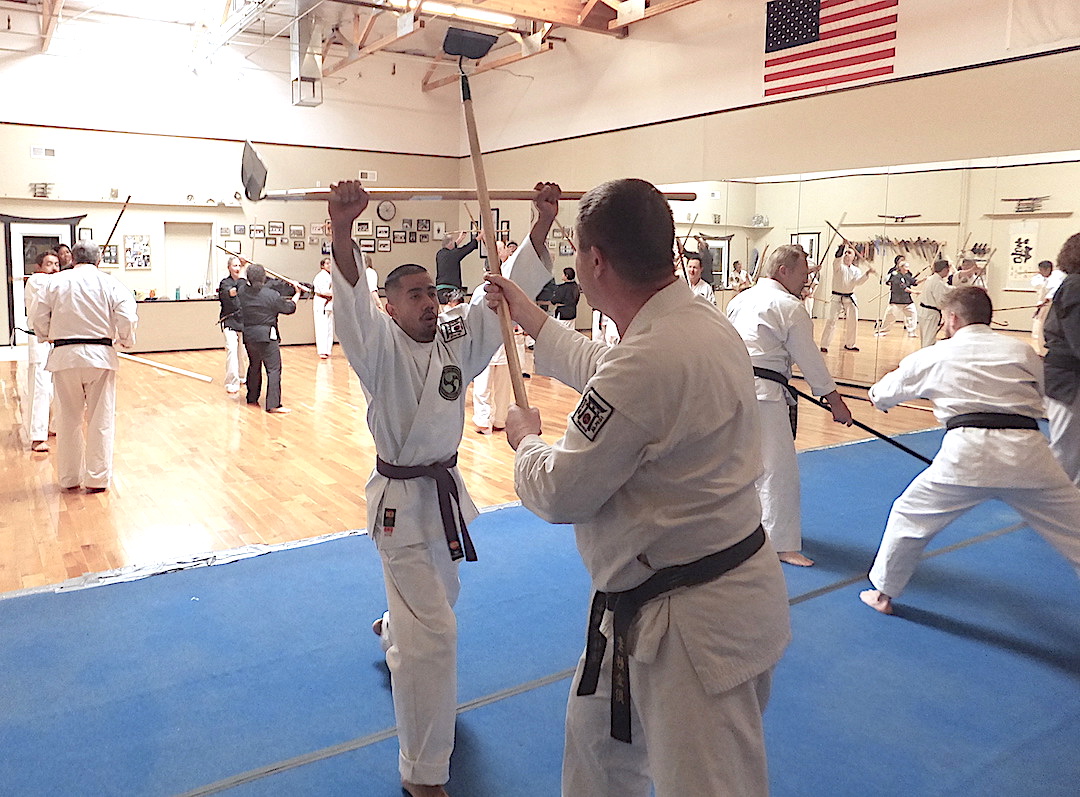
Paula (2nd dan) defends using kuwa (garden hoe) during kobudo training in the East
Valley of Phoenix Arizona.
Traditional Okinawan Shorin-Ryu Karate training also involves training in kobudo (the ancient art of traditional weapons), jujutsu, shitai kori (body hardening) and much more. At the Arizona School of Traditional Karate in Mesa (also known as the Hombu for Seiyo No Shorin-Ryu Karate Kobudo Kai in Gilbert and Chandler) our adult students are learning how to effectively use their hands and feet as well as how to use their garden hoes and other gardening equipment and tools for weapons of self-defense. Come see what our students can do.  Or stop by FOX 10 NEWS and see what we are up to.
Dr Neal Adam (5th dan) hooks back of Rich Mendolia's knee during bunkai training with kuwa (garden hoe) and
bo (6-foot staff) at the Arizona School of Traditional karate in Mesa, Arizona

Wednesday, August 31, 2011

TONFA CLASS STARTS at MARTIAL ARTS SCHOOL in MESA, GILBERT and CHANDLER

Rich Mendolia from Mesa uses bo during kobudo training at the Arizona School of traditional
karate in Mesa, while Dr. Neal Adam from Grand Canyon University in Phoenix uses tonfa.
Sarah defends herself using tonfa
against bo attack by Amber
TONFA in MESA and GILBERT
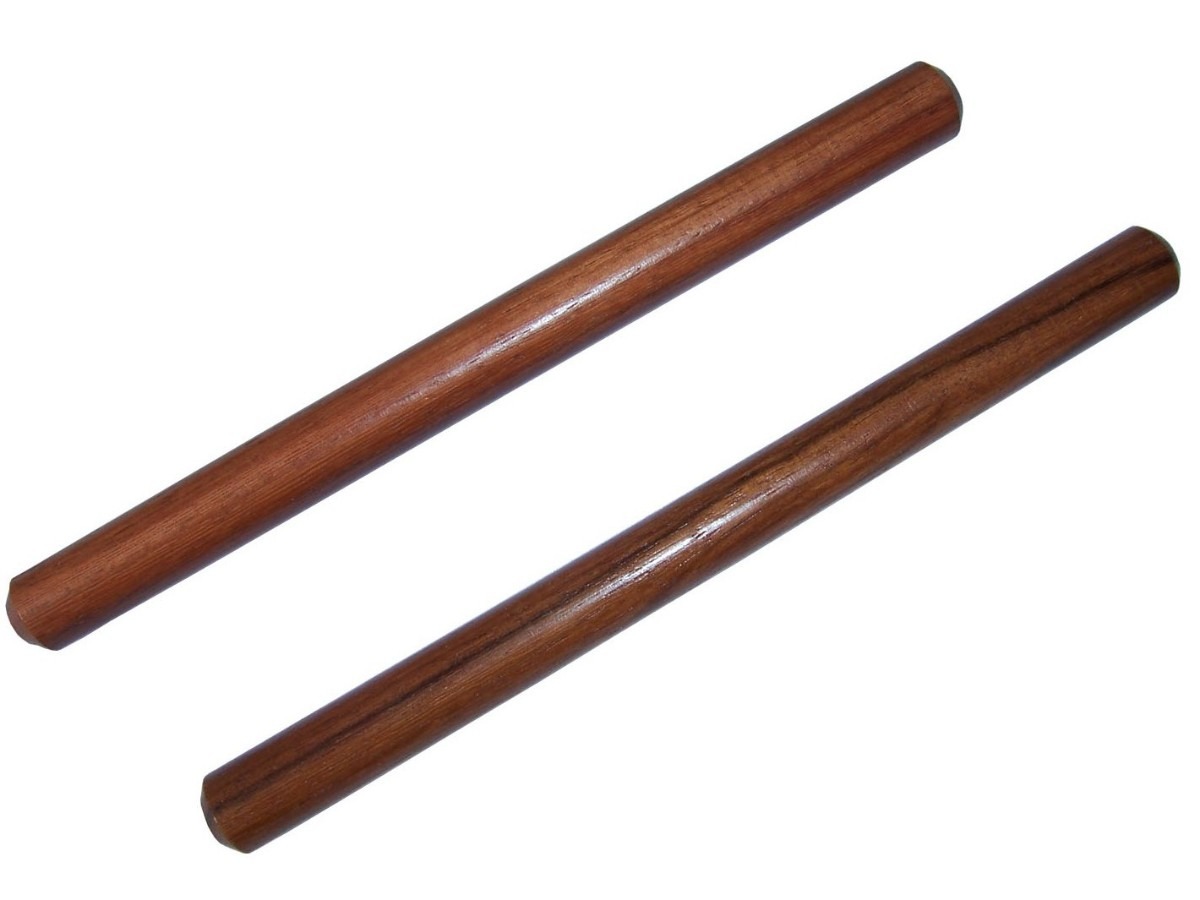
Members of the Arizona School of Traditional Karate at the Seiyo Kai Hombu in Mesa and Gilbert in the East Valley of Phoenix began training in Tonfa-Jutsu in August of 2011. Our members (deshi) discovered that these weapons are very similar to their empty hand (kara-te) techniques with all of the typical blocks and strikes. In the forthcoming weeks, they will learn to use these weapons with different grips as well as learn three kata (forms) and all of the bunkai (applications).

Dr. Neal Adam follows up block with strike using
tonfa against Ryan Harden's attack with bo.
The origin of the tonfa cannot be established without question, but some researchers assume the tonfa were originally rice mill handles that were removed from a rice grinder in Okinawa at time of need for self-defense against marauding Japanese samurai. The weapon was so effective that after karate was introduced to Japan in the 1900s, many police departments adapted the weapon for use as a night stick worldwide. But unlike law enforcement, our students learn to use two tonfa rather than one and learn to use them effectively for blocking, striking, hooking, choking, and even some throws.

Look for the 'KARATE' sign above
our door on MacDonald at the corner
with Baseline Road (NE corner).


The Arizona School of Traditional Karate accepts adults into its program with or without formal training in martial arts. We have some of the lowest prices in the East Valley and offer the most diverse training in Okinawan and Japanese karate, kobudo and samurai arts in the state.

Feel free to stop by and watch a class to see if you would like to take part in group lessons - we have no salesmen to pressure you and you will only find that you are accepted as a friend. We have a 30:70 ratio of women to men and we all look forward to being educated about martial arts history, philosophy and self-defense. We are all friends at our dojo in Arizona.

Classes are held at the Seiyo Kai Hombu on the border of Mesa, Gilbert and Chandler. The easiest way to get there is to drive east on Baseline from Walmart at Baseline and Country Club (Arizona) Road. When you come to the second traffic light, turn left onto MacDonald and right on the northeast corner you will see a group of businesses with one labeled "KARATE" above the door - you found us!  Call if you have problems.
Patrick Scofield defends with tonfa against a bo attack by Neal Adam

Along with kobudo classes, we also provide some acting classes (not really). Here Neal Adam (5th dan)
from Phoenix trains with Rich Mendolia (3rd kyu) from East Mesa.

Charles Jean (6th kyu) and Ryan Harden (5th kyu)
spar with bo and tonfa.
Group tonfa training on Thursday evening Kobudo night at
Arizona School of Traditional Karate in Mesa, Gilbert, Chandler 
in the East Valley of Phoenix.


Traditional Karate
by Arizona School of Traditional Karate - Mesa

Tuesday, May 4, 2010

KOBUDO - the Art of Weapons

At the Arizona School of Traditional Karate in Mesa and Gilbert Arizona as well as all of the Seiyo No Shorin-Ryu Karate Kobudo Kai schools in Wyoming and elsewhere, we practice the kobudo and kobujustu arts of Okinawa and Japan. These arts are still practical today. By learning the kobudo arts, one can use a belt, a stick, a baton, car keys, cell phone, and most anything as a tool of self defense. Kobudo is a martial art that is sometimes blended with karate, especially in the Okinawan systems.


There are many fighting systems, but only a few can be classified as a martial art. Boxing is not a martial art, wresting is not a martial art, MMA is not a martial art as these do not fit the definition of martial art. ‘Members of Seiyo No Shorin-Ryu Karate Kobudo Kai practice kobudo and kobujutsu. By learning these disciplines, a person is prepared to use their belt, pen, baton, car keys, cell phone, book or most anything they can get their hands on as tools for self defense. At this moment, think about what you are wearing, what you have in your pockets, what is near you – what kind of weapons do you have? How could you use these for self-defense. Or imagine you are going to teach a class in kobudo and you can only use what tools you find within 3 feet of you. How would you use these for blocks and strikes?


Kobudo is a martial art that blended with karate in the Okinawan systems. However, there are many Asian and American hybrids that have elected to remove kobudo from their curriculum for unknown reasons. Even many of the Japanese karate styles have eliminated kobudo in the 20th century.When I trained in Kyokushinkai, Kempo, Wado-Ryu and Shotokan, no weapons were ever introduced, or even mentioned.

There are many fighting systems in the world, but only a few can be classified as martial art. ‘Martial’ translates in Japanese as bu, a word found in budo. Budo translates as ‘martial ways’ implying that there is some form of mental or spiritual benefit. Bushido translates as the way (or path) of bushi (warrior) or basically a warrior’s code of ethics. Other words that use bu as a root include bujutsu which is different than budo. Bujutsu refers to the old (koryu) Japanese martial fighting methods and schools that were developled by feudal samurai, whereas budo refers to modern fighting arts that have included a spiritual and ethical emphasis. Kobujutsu refers to ancient fighting methods of the samurai which is different than kobudo – the art of ancient weaponry.
Seiyo Kai International Icon- copyright
Soke Hausel


Systems of kobujutsu have been practiced in Japan for centuries. In Japan, kobujutsu was for the most part, restricted to samurai. Whereas on Okinawa, kobudo was considered a peasant’s art. Jutsu translates as a skill or discipline and does not suggest any philosophical self-perfection suggested by ‘do’. Thus karatejutsu is a group fighting skills with no spiritual goals or emphasis, whereas karatedo is a method of empty hand fighting techniques that has as its goal; self-improvement of the person. In a strict sense, it could be argued that karatejutsu is not a martial art as it does not provide any esoteric value.


Valid martial arts have always had an underlying code of ethics and spiritual benefit. We can see the evolution of this code by examining legends surrounding the progenitor of martial arts. According to these legends, some form of martial art was introduced to the Shaolin monks in the Henan Province, northern China around 520 AD by an Indian monk named Bodhidharma. Bodhidharma is believed to have introduced Zen Buddhism to China and is considered the father of martial arts.


Bodhidharma was a son of an Indian King. He traveled from southern India to China during the Liáng Dynasty (502–557AD). His route took him through the Himalaya Mountains and it is said he carried two books known as the I Chin Ching and Hseiu Seu Ching that are suggested to have contained descriptions of self-defense techniques. Bodhidharma crossed the Yangtzu River and continued north where he took residence at the Shao Lin Temple in Ho Nan Province. There are countless legends about this individual, although many are exaggerated. For example, Bodhidharma is described to have attained enlightenment while meditating and facing a wall of a cave without blinking his eyes for 7 to 9 years at the Shorinji Temple (少林寺) on Mt Song (嵩山).


At the temple, he began lectures in Zen. Each evening, he would climb down from a nearby cave to the monastery and lecture. Apparently early on, he discovered that the Shaolin monks were unfit and lazy and often fell asleep during mediation. To correct this he began teaching a set of physical exercises in conjunction with meditation called 'Shi Po Lohan Sho' (18 hands of Lohan) that are reputed to have been a fighting form from India. By adding physical training with spiritual training, the monks began to gain focus. Thus he created the first martial art whether by accident or design that combined spiritual and physical training. Following years of meditation and ch'uan fa (kung fu) practice, the Shaolin monks developed a reputation as enlightened priests and formable fighters throughout China. Many Lohan techniques that were taught, were derived from a study of animals – such as a tiger or crane. This resulted in a variety of forms of ch’uan fa, such as tiger kung fu, monkey kung fu, white crane kung fu.
My Personality (copyright) Sketch by Soke
Bodhidharma’s cave located north of the monastery is described to be a square-mouthed cave about the size of a small room that opened directly to the sun. Legend claims that he stopped returning to the monastery after some time and just sat continuously facing the wall of the cave, legs crossed, in silent contemplation. After facing the wall for three thousand days, his shadow was preserved on the stone face. It is said that from a distance, one can still see the shape of a man sitting cross-legged with his hands pressed together on the rock face.


Centuries later, kung fu was introduced to Okinawa. But Okinawans took the characteristic circular and gymnastic-like movements of kung fu and modified them into linear, pragmatic and powerful techniques. How, why, and when this evolution occurred is unclear. History records an important event that may have influenced the introduction of kung fu to the Ryukyu (Okinawa) Islands. In 1374 AD, China and Okinawa formalized trade relations. The event was accompanied by an imperial gift from China in the form of 36 families of skilled artisans and merchants who migrated from Fukien (also known as Fujian) Province of southeastern China to Okinawa. These families established a community known as Kumermura near Naha City. It is suggested that members of these families introduced kung fu to Okinawa. Although others suggest that the 36 families were not educated in martial arts and rather than various Okinawans traveled to China to study the Chinese hand (known as Tode to the Okinawans).


Tai Chi Lady (copyright) - sketch by
Soke Hausel
A martial arts text known as the Bubishi was thought to have possibly accompanied the Kumermura families. The Bubishi is interpreted as a textbook of White Crane kung fu methods that were originally taught in the southern Shaolin temple at Chiu Lung Mountain near Foochow City in the Pu T'ien District of the Fukien Province. The originator of the White Crane Fist style is believed to have been Fang Chi Liang, a woman who resided in Yong Chun (for those of you who attended the UW yudansha clinic in March, you were introduced to this art). The Bubishi includes martial arts techniques but it is a seemingly paradoxical document that stresses preservation of human life (a tenant of Buddhist philosophy), yet teaches Okurasu Goroshi or vital point strikes designed to knock out, maim, or kill an opponent.


The Chinese influence on karate is seen in kanji used to describe tode. The kanji refers to the T'ang Dynasty (618-907 AD) (the golden age of culture for China) as well as to China in general. Literally, the kanji means 'Chinese hand'. Furthermore, the kanji used to describe Shorin-Ryu is translated as Shaolin style in Chinese in reference to the Shaolin temple in the Henan Province.


Te (copyright) - sketch by Soke Hausel
The term for tode (Chinese hand) was later changed to karate. Karate is derived from the Japanese kara meaning empty, and te meaning hand. When speaking of karate, traditionalists attach the word do (‘way’ or ‘path’). Translated, karatedo means the 'way of the empty hand'. Many people would take this at face value meaning a method of bare-handed self defense. But the ideograph used for 'kara' not only represents empty, but also represents 'void' or sunyata. Sunyata is the Sanskrit term for emptiness or nothingness which has profound, meaning in Buddhism. In principal, sunyata` is derived from a Buddhist concept of 'no-mind', a form of Zen training that in essence, is an ego-less state of mind that frees one from fear of death or failure.


In 1480 AD, Okinawan King Sho Shin issued an edict that prohibited the private ownership of bladed weapons. The king, being nonviolent Buddhist, believed his subjects should also be nonviolent. But not all were as peaceful as the king. Following the edict, secret societies formed to practice te and kobudo as a means of self protection. Farmers and fishermen developed fighting methods using tools of trade and karate and kobudo were blended. These became methods for individual self-defense rather than for military such as that of the samurai of nearby Japan.


The ban on bladed weapons and with no military, it was a matter of time before Okinawa would be invaded. Thus in 1609 AD, Lord Shimazu with the Satsuma Samurai Clan of southern Japan obliged Okinawa and invaded and conquered the Ryukyu Islands with little resistance. The 3000 samurai invaders left the political and sociological infrastructure in tack and ruled indirectly by levying high taxes while assuming control of Okinawan’s foreign trade that had been robust. This led to rapid decline of the Okinawan economy. During this time, karate was developed into a pragmatic method of self-defense.


Kyoshi Rob Watson (8th dan) explains the difference between
Kendo and Kenjutsu at clinic in East Canyon of Utah as Soke
Hausel (10th dan) from Mesa, Arizona looks on.
The samurai banned the practice of martial arts. This stimulated the evolution of karate and kobudo as virulent arts. It is likely that kata became prominent in the Ryukyu culture at this time as a means to disguise the art from the Japanese, as well as a method for preserving favorite and effective techniques. Karate and kobudo were practiced in secrecy for more than 400 years: documents about karate during this period of development are nonexistent as the art was kept completely secret.


In 1868, the Meiji restoration of Japan abolished feudalism along with the rule of Samurai. Samurai could no longer wear swords in public and the government abolished the Ryukyu Kingdom essentially making Okinawa a feudal clan of Japan in 1872 (even though feudalism had been abolished in the rest of Japan). The Satsuma rebelled against the Meiji government in 1877 but were conquered by the modern Japanese army. This was followed by the Japanization of Okinawa in 1879 and the last Okinawan King was exiled to Tokyo and a Japanese governor replaced him in Shuri City.


Soke Hausel (10th dan) demonstrates teisho uchi (palm strike)
with the help of Kyle Gewecke (4th dan) from Gillette Wyoming
Many of these events lead to development of karate techniques into highly effective strikes designed to paralyze, kill, or maim an opponent with a single blow. Kata incorporated omote (hidden techniques) , okurasu goroshi (death blows), and tien hsueh (vital point strikes). A master of kobudo, using tools of trade as weapons, could defend against a well-armed aggressor and body hardening methods evolved to the point that some Okinawans were able to take full-force blows to any point on the body with little effect. This philosophy of ‘one strike – one kill’ was used effectively by all Shorin-Ryu styles until the late 20th century when many forms of sport karate eliminated most pragmatic applications of karate and kobudo.


In 1901, Anko Itosu of Okinawa (Itosu Yasutsune in Japanese) was instrumental in introducing karate into the Okinawa public schools. To simplify karate, Itosu developed the pinan (peaceful mind) katas from two advanced kata forms known as kusanku (kanku in Japanese) and chiang nan. The kusanku kata still exists but the chiang nan kata, known as the channan kata, was lost. Itosu also broke down the complex naihanchi kata (tekki in Japanese) into 3 separate naihanchi forms.


The father of modern Karate
Gichin Funakoshi (copyright) - sketch
by Soke Hausel
Many Okinawan karate masters were concerned about providing Japanese with the secrets of their system. But the secrecy of this self-defense and self-enlightenment art continued to come out in the open. Following introduction of karate into public schools, Gichin Funakoshi presented the first public karate demonstration on Okinawa in 1902. Both Itosu and Funakoshi were school teachers and masters of Shorin-Ryu karate. Even with the eventual introduction of karate to Japan, it was apparent that the Okinawans did not trust the Japanese. Many techniques (bunkai) taught to the Japanese were incorrect and ineffective and Funakoshi also taught a watered-down version of Shorin-Ryu karate to the Japanese. Funakoshi also taught karate should not be used against others and instead should be used to improve oneself. He also did not support (as did many Okinawan masters) karate being developed into a sport. Karate instead was to be used as a way of cultivating the spirit.


Jessica Ricks (2nd dan) from California demonstrates kama
 kata at University of Wyoming.
In 1917, Gichin Funakoshi traveled to Kyoto to demonstrate Okinawan karate. In 1922, at the age of 53, he was invited back at the request of Japanese officials for another demonstration of karate. Following this second demonstration, karate was formally accepted on mainland Japan. In 1936, Funakoshi established a permanent dojo in Tokyo known as the Shotokan. Funakoshi's training philosophy was that kata, makiwara training, and kotekitae (body hardening) was all that was necessary in preparation of self defense. This is a similar philosophy of Seiyo Shorin-Ryu Karate and Kobudo taught at the University of Wyoming, Casper, Wyoming, Gillette, Wyoming and at the Mesa Arizona Hombu. For some reason, the Japanese karate did not include kobudo although early photographs of show Funakoshi demonstrating bojutsu.


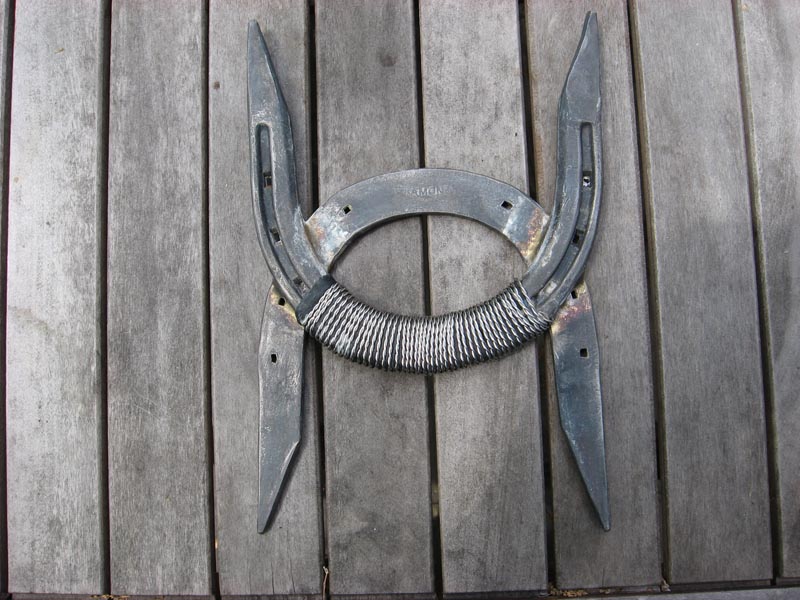
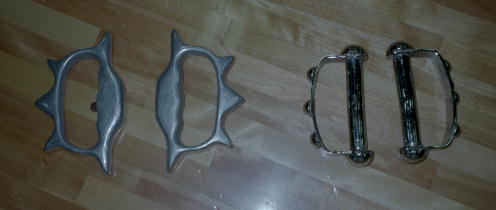
The Okinawan kobudo weapons include: sai, nunchuku, Tonfa (police baton), Sai, Kama (Sickle), Hanbo (half-staff), Nitanbo (two sticks), Cane, Bo (staff), Kobutan, Eku (oar), Ra-ke (rake), Kuwa (hoe), Manrikigusari (rope), Tanto (knife), Hari (fish hooks), Nireki (two rakes), Surichin (weighted rope), tetsubo (stinger), tekko, tinbe, yawara, suruji, tanto and more.


One of the more common weapons is the bo - a 6-foot staff. The bo has been used and still is used by Okinawan (and Asian) farmers to transport materials. The bo is placed over the shoudler and goods attached to either end. But when needed - the bo is quite handy to the Okinawan farmer.

Dr. Amit Diksit from India, PhD in Electrical Engineering practices
with bo at the University of Wyoming Campus Shorin-Ryu karate
 and kobudo club
The sai is a dagger is a dagger-shaped truncheon that has a pointed truncheon with two curved prongs known as yoku that project from the handle. Most have parallel yoku, but another sai with opposing yoku is also used. Typically two zai are used, but three zai may also be employed with two held in hand and the third sai held in the obi (belt). The tonfa (also tuifa) is thought to have been a handle for a millstone. It is such an effective weapon that it became in popular use by police departments worldwide. Another weapon that is a baton, similar to the hanbo (or half bo) is the kioga (expandable baton), which is now taught in many kobudo schools. Other weapons that are now included in kobudo are the katana (samurai sword) once outlawed on Japan as well as the yari (spear) and naginata (halberd).


Sensei Kyle Linton from Wellington Colorado blocks tanto (knife) attack from Hanshi Andy Finely (7th dan) from Casper, Wyoming at a University of Wyoming martial arts clinic.
At the Arizona School of Traditional Karate, we teach clinics to specialty groups such as political organizations, engineering firms, church groups, women's groups, ROTC, military, law enforcement and we also teach kobudo to our members of our organization and to our Arizona Students.

Kobudo Class: Thursdays (6:45-7:50 pm).
Advance Kobudo: Thursdays (7:50 to 8:20 pm).

Self-defense Class: Wednesdays (6:45-7:50 pm)
Samurai Arts Class: Wednesdays (7:50-8:20 pm).

Basic Karate Classes: Tuesdays (6:45-7:50 pm).
Advanced Karate Class: Tuesdays (7:50-8:20 pm).

We also have Adult Karate & Kobudo Class on Wednesdays (3-4 pm) & Shorin-Ryu Kids Karate Class Wednesdays (4-5 pm).


All artwork is the property of Soke Hausel.


Contact us for more information.


Find us at 60 W. Baseline Road in Mesa across the street from Gilbert and Chandler, Arizona.

        
Karate Phoenix